Interrail in summer
Is an Interrail Pass Worth It for a Summer Trip in Europe?
An Interrail pass is worth it when the trip is a route rather than a list of flights, and summer is exactly the season where that difference becomes visible. The pass is bought in travel days, not in kilometres, and the arithmetic only works on the legs where the rail network is dense. Below: the mechanics of the pass, the routes that pay for it, the reservations that do not come with it, and what your phone has to do for the whole journey to work.
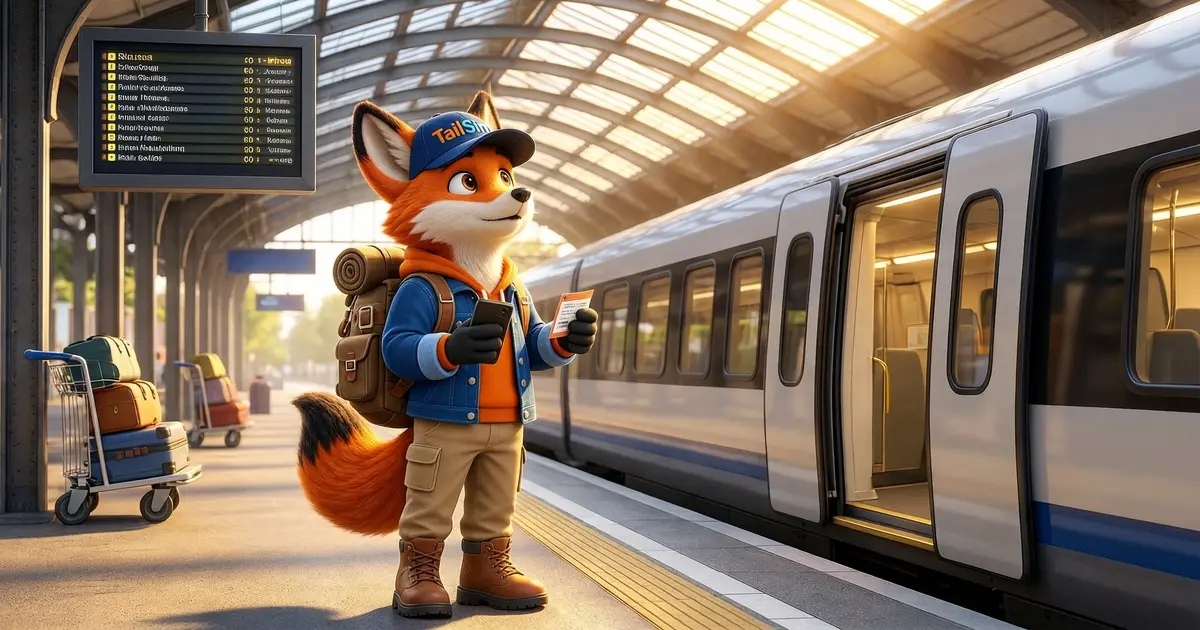

An Interrail pass is worth it when the trip is a route rather than a list of flights. Summer is the season where that distinction is clearest: the reservations for the popular trains disappear months ahead, the sleepers are full, and the alternative — the same journey flown hop by hop — costs more time than money. The pass itself is easy to understand once you stop thinking of it as a ticket and start thinking of it as a number of travel days.
Key Takeaways
- An Interrail pass buys travel days inside a longer validity window, and those travel days do not have to be consecutive.
- One Country Passes come in 1, 2, 3, 4 and up to 15 travel days inside one month; the global pass runs in consecutive blocks or in non-consecutive days.
- The pass does not include the seat reservation, and some high-speed and night services add a supplement on top.
- The train wins door-to-door on short legs between dense networks — the Netherlands, Germany, France, Italy and Spain — and loses on long crossings.
- Summer reservations open months in advance, so the pass only pays if the seats are booked early.
- The ticket lives on the phone, so a rail trip needs mobile data from the first station to the last.
How does the Interrail pass system actually work?
An Interrail pass is not a ticket for a route: it is a bundle of travel days that you use inside a longer validity window, and every train you board on a given day falls under that day. The distinction between a travel day and a calendar day is the whole mechanism, and it is what separates a pass from a ticket.
| Format | What you buy | When it fits |
|---|---|---|
| One Country Pass | From 1 to 15 travel days inside a one-month window | A trip that stays in one country, or starts and ends there |
| Global pass, consecutive | 5 to 30 travel days in a row | A route that moves every single day |
| Global pass, Flexi | Up to 15 travel days, non-consecutive, inside the window | A route with rest days in the middle |
Three rules decide how the days are consumed:
- A travel day can be split into two half-days, each covering one journey, which is why a single day out of your base city and back still counts as one.
- Boardings between 23:00 and 04:00 count against the previous calendar day. That is the rule that makes the night trains work: you leave late, you arrive early, and you have used one travel day.
- The pass does not cover the seat reservation on most trains, nor the services that carry a supplement.
On that last point the wording matters: the reservation is a separate booking with its own cost, and on the services that require one the pass does not absorb it. Prices for the pass and for every reservation are revised year by year, so the current list has to be checked before committing to a format.
When is a rail pass cheaper than flying between cities?
The comparison that decides it is door-to-door time, not the price of the ticket. A flight is not the time on the plane: add the trip to the airport, check-in and security in high season, the flight itself, and the transfer from the arrival airport to the city. The train adds only the walk from the station, because European main stations sit in the middle of the city.
| Leg | By train | By air | Winner |
|---|---|---|---|
| Brussels – Amsterdam | around 1 h 20 | no flight that makes sense | Train |
| Paris – Strasbourg | under 2 h | flight plus two transfers | Train |
| Madrid – Barcelona | around 2 h 30 | flight plus two transfers | Train |
| Milan – Rome | around 3 h | flight plus two transfers | Train |
| Amsterdam – Berlin | around 6 h | flight plus two transfers | Train |
| Hamburg – Munich | around 5 h 30 | flight plus two transfers | Close |
| Southern Spain, Sicily or the far north | all-day train | flight | Flight |
The train loses in two situations. The first is the long crossing — to the far north of Norway, to the Baltic states, to Sicily or to the southern tip of Spain, where the direct train is an all-day run and the flight, transfers included, still arrives first. The second is the pair of cities that no high-speed line connects: there the plane wins on hours and the pass has nothing to add.
It also loses on the legs where the train does not exist as a product, which is why the summer route that works best is a chain of short hops rather than one long haul.
Which European routes are worth doing by train?
The routes worth doing by train are the ones where the network is dense, the trains are frequent and the two cities are close enough that the train wins door-to-door. Five corridors cover most of the interesting summer itineraries.
| Route | Why it works | What to watch |
|---|---|---|
| Netherlands – Germany – Poland axis | A continuous high-speed corridor from Amsterdam through Berlin | The Berlin corridor fills up first in summer |
| Paris – Strasbourg – Basel – Zurich | One of the fastest short corridors in Europe | TGV reservations are mandatory and some services carry a supplement |
| Alpine crossings, Basel – Zurich – Milan | Frequent daytime trains plus night services | Night departures need their own booking |
| Southern axis, Madrid – Lisbon and Barcelona – Montpellier – Lyon | The Iberian corridor links two countries without a flight | AVE and the Spanish long-distance trains require a reservation |
| Night trains, sleeper and couchette | The pass includes the berth, so the journey replaces a hotel night | Some night services add a supplement, and they sell out first |
The night trains deserve a separate mention, because they are the strongest single argument for the pass in summer. A couchette or sleeper berth on a covered service is part of what you paid for, the journey runs while you sleep, and you arrive in the centre of the next city at breakfast. That is a hotel night removed from the budget and a flight avoided in the same move.
Do I need seat reservations on top of the pass?
Yes, in three countries, and in the rest it depends on the service. The rule of thumb is simple: high speed means reservation, and reservation means a second cost that the pass does not cover.
- France — the TGV services require a seat reservation, and the fastest of them carry a supplement that an Interrail pass does not absorb.
- Italy — the Frecce high-speed trains require a seat booking, with a fee on most departures.
- Spain — AVE and the other long-distance Spanish services require a seat reservation, also with a fee.
- Germany, Austria, Switzerland, Belgium, Poland and the Netherlands — a reservation is optional on most trains, but it is required or strongly advised on a few peak services, including the busiest German intercity routes and the international departures from the Netherlands.
- Night trains — the berth is included on the covered services, but the seat or berth booking may still carry a fee, and some night trains are not covered by the pass at all.
The practical consequence for summer is timing. Reservations for the high-demand dates open months ahead, and the popular departures in France, Italy and Spain disappear in hours rather than days. If you book the pass and then the seats, you may end up paying a seat reservation for a later train, which changes the itinerary; if you book the seats first you know exactly which trains your travel days have to cover.
Is summer the best season to travel by rail in Europe?
Summer is the best season to travel by rail if you book early, and the worst one if you do not, because demand for a seat peaks exactly when the supply of seats does not. The season brings three specific problems, and one specific advantage.
- Reservations sell out with months of anticipation. For the peak dates in France and Spain the summer services are fully booked long before the summer starts, and the later departures are the ones left.
- The rolling stock changes. The busiest corridors run extra seasonal trains, and those go first; the regular services get fuller as the weeks pass.
- The heat on board is what pushes people back to the plane. Modern high-speed carriages and the newest sleepers have air conditioning, but older stock does not always, and that is when the flight comparison returns.
- The advantage is geography, and it does not change with the calendar. An airport is never in the city centre. In summer, going from one hot, crowded airport to another hot, crowded airport costs hours of transfers, while the train drops you in the middle of the next city with your luggage already with you.
The busiest weeks are the height of July and August. The shoulders at the beginning of June and the end of September are calmer, and the guide to the best months for a European summer maps which countries peak when.
How do you work out whether the pass pays for itself?
Whether the pass pays for itself is not one comparison, it is a sum of five items, and the item that surprises people is the last one. Prices for the pass, for reservations and for flights are revised every year, so the current figures have to be checked before you commit to a format.
| Item | How it behaves |
|---|---|
| The pass | One price for the number of travel days you activate, paid before departure |
| Seat reservations | Charged per train on the services that require them, and not included in the pass |
| Food and drink on board | Higher than in the city, though the night train removes a hotel night |
| Flights avoided | Counted door-to-door, not on the departure board |
| Airport transfers | The hidden cost of flying, on both ends of the journey |
Four steps turn that into a decision:
- Count the travel days first. Only the days on which you actually board a train count on a non-consecutive pass, so rest days cost nothing. On a consecutive pass they cost a lot.
- Price the reservations for the trains that need them. Add the compulsory seat bookings of the French, Italian and Spanish services, and check the supplements on the night trains, before comparing anything.
- Compare door-to-door, not flight time. Include the airport transfers and the security queue on the flight side, and the station-to-hotel walk on the train side.
- Check the exclusions. Some premium, high-speed or night services are outside the pass, and a route that depends on them is not a route the pass solves.
The answer that emerges most often is that the pass is worth it for a route of three or four short hops plus one night train, and not worth it for a triangle of distant cities.
What happens to your data when the train crosses a border?
A rail trip is a mobile data trip. The pass, the seat reservations and the night-train bookings travel on the phone, and the conductor scans a QR code that the phone has to be able to display — which means a rail trip needs mobile data working from the first station to the last, including the tunnel between two countries.
The Europe regional plan fits this itinerary because it covers 32 countries and changes operator only when you cross a border, without reinstalling the profile. The prepaid line runs from 1 GB / 7 days at $4.99 up to 50 GB / 30 days at $96.99, and the unlimited line from 3 days at $8.99 to 30 days at $67.99, with 3 GB a day at full speed and then 1 Mbps.
The consumption rule of thumb for a rail trip is the same as for any other trip, because the phone does the same work: 3 to 5 GB for a week across one or two countries, 5 to 10 GB for two weeks across two or three countries, and 15 to 30 GB for a month on the move. The details of what each plan includes are in the guide to what an eSIM costs.
Set against that, the home operator’s roaming package is the expensive way to keep the same connection alive: international roaming commonly runs at $5 to $15 per day with unlimited use, or $2 to $5 per megabyte on metered plans, which turns a two-week rail trip into a bill of around $140. The real failure mode on a train is not the price of the data but the gap: a screen that cannot load a QR code is a traveller without a valid ticket, and the tunnel under the Alps is exactly where that happens.
One last precaution costs nothing: download the pass and every reservation before you board, and keep a screenshot of the day ticket. The train will not wait for the signal to come back.

Get 5% off your eSIM
Claim my 5% offFrequently asked questions
Is an Interrail pass worth it for a summer trip in Europe?
It is worth it when the trip is a route and the rail network is dense — the Netherlands, Germany, France, Italy and Spain — and twice over with a night train in the itinerary. It is not worth it for two distant cities with no high-speed link. The pass buys travel days, so count the ones you actually use.
How many travel days do I need for a two-week Interrail trip?
Only the days on which you board a train count, and on a non-consecutive pass the rest do not. A two-week summer route with two rest days usually needs around ten travel days; the same trip on a consecutive pass needs the full fourteen. One Country Passes cover 1 to 15 travel days inside one month.
Does the Interrail pass include seat reservations?
No, not in general. In France, Italy and Spain the high-speed services require a seat reservation and charge for it, and the pass does not remove that charge. In Germany, Austria, Switzerland, Belgium, Poland and the Netherlands a reservation is optional on most trains, though some peak services require one.
Is the train cheaper than flying between European cities?
The honest comparison is door-to-door time, not the price of the ticket. A flight adds the trip to the airport, check-in and security, the flight itself and the transfer from the arrival airport to the city. The train adds only the walk from the station, and that is why it wins on short legs.
Do night trains count as a travel day?
Yes, and a night train is often the best use of a travel day. If you board between 23:00 and 04:00 the journey counts against the previous calendar day, so you arrive in the morning of the next one and use a single travel day. On the covered services the pass includes the berth.
What data plan do I need for a rail trip across Europe?
A week on trains across one or two countries needs around 3 to 5 GB, two weeks across two or three countries 5 to 10 GB, and a month of travel 15 to 30 GB. The Europe regional plan covers 32 countries and switches network only when you cross a border, and your phone must show the ticket QR code.